Hooray! It’s time for the Defender warehouse sale!

One of the things we kept hearing after we bought our boat was to mark our calendar for the annual Defender warehouse sale.  At the time we had never heard of Defender, let alone the annual sale, but soon we discovered the glory that is Defender.  We have made many, many, many stops there when driving to the boat.

Defender is a gigantic marine outfitter that ships items worldwide.  99% of the time, they have the lowest prices on any given item. They have over 50,000 marine products in a 110,000 square foot warehouse, and fortunately (or not, depending on how you look at it), they are located within 15 minutes of our marina.  It’s become a running joke between us.  We’ll go there several weekends in a row and finally we’ll look at each other as we’re driving away and say, “I think that should be our last trip for a while.”  Then we’re back again the following weekend.

Home Depot for boaters.
Red right return to Defender!

The end of February brings the arrival of the annual Defender catalogue – over 300 pages filled with marine goodness.  We look forward to it as if we were kids waiting for the Sears Christmas catalogue.  It is pored over in detail, lists are made and remade.  And then, it finally arrives – the last weekend of March.  The Defender warehouse sale.

The warehouse sale runs from Thursday through Sunday, and those four days represent 20% of Defender’s annual sales.  Their already-low prices are discounted at least 10% further, and there are many blowout deals.  Tons of vendors are available to answer questions about their products, similar to what you would find at a boat show.  Coming at the end of winter, the place is mobbed with boaters who can’t wait to start the season.  It has the feeling of the first day of school – everyone is excited and seeing people they haven’t seen all winter.  The Rotary club even sells hotdogs and chips from a cart.

Last year was our first Warehouse sale and we were very impressed with how smoothly everything ran.  You can tell that Defender has a lot of experience with this.  Normally only a portion of the warehouse is open to the public, but for the Warehouse sale they open up the entire area.  You can get things from the shelves yourself, or if the items aren’t on the shelves you can give the sales staff the product numbers and they’ll pull it for you from the back shelves.  They have a projector on the wall with last names displayed as your order is ready so you can talk to the vendor reps (or browse) instead of hanging around waiting for your order.  Typically there are three cash registers, but for the sale Defender sets up well over twenty so even though the line is snaking through the warehouse it moves very quickly.

We had hoped to arrive at Defender on Saturday when it opened, but it didn’t quite work out that way.  We ended up parked along the side of the road, quite a ways from the entrance, but it didn’t matter – it was time for the Warehouse sale!
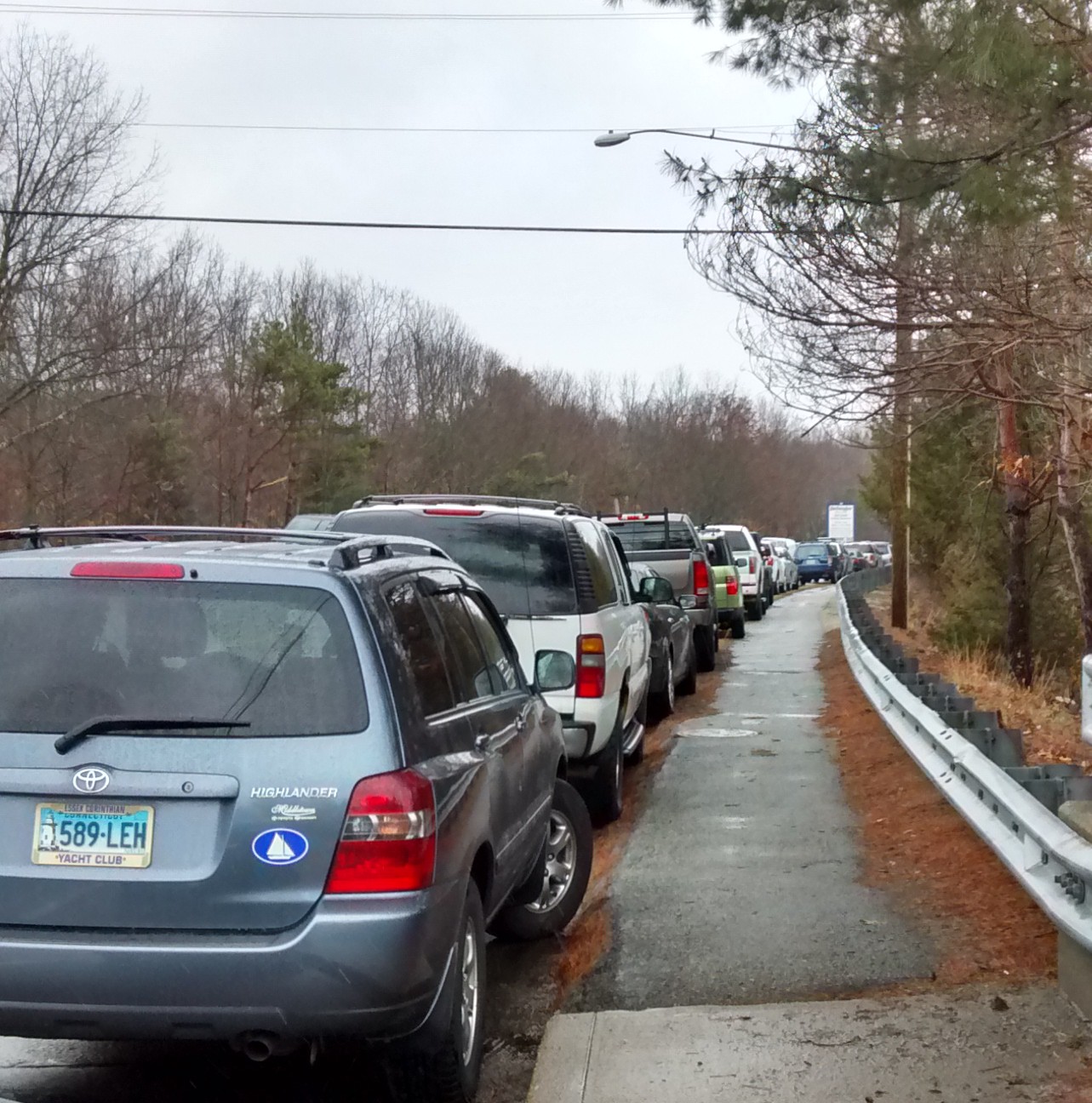
The white sign at the end of the road marks the entrance to the long driveway.  Cars were parked all along the driveway and the parking lots were jammed.
The white sign at the far end marks the entrance to the long driveway. Cars were parked all along the road and the driveway and the parking lots were jammed.

List in hand, we immediately ran into a coworker of mine and chatted for awhile.  I asked him if he would be coming back the next day and he said no, and I said we wouldn’t either.  We had our list and we were ready.  It was time to get down to business.

Just a few of the many aisles.

Even though we aren’t in the market for a dinghy (and we won’t buy another inflatable one regardless), it’s fun to see the displays of all of the models.  Defender is the largest inflatable boat dealer in North America, and the largest Zodiac and Achilles dealer in the world.  They have all of their available models displayed for the warehouse sale.

IMG_3620
The room was too big for me to capture all of it.

IMG_3621

We collected our items from the pickup area, including our much-researched anchor, rode and chain.
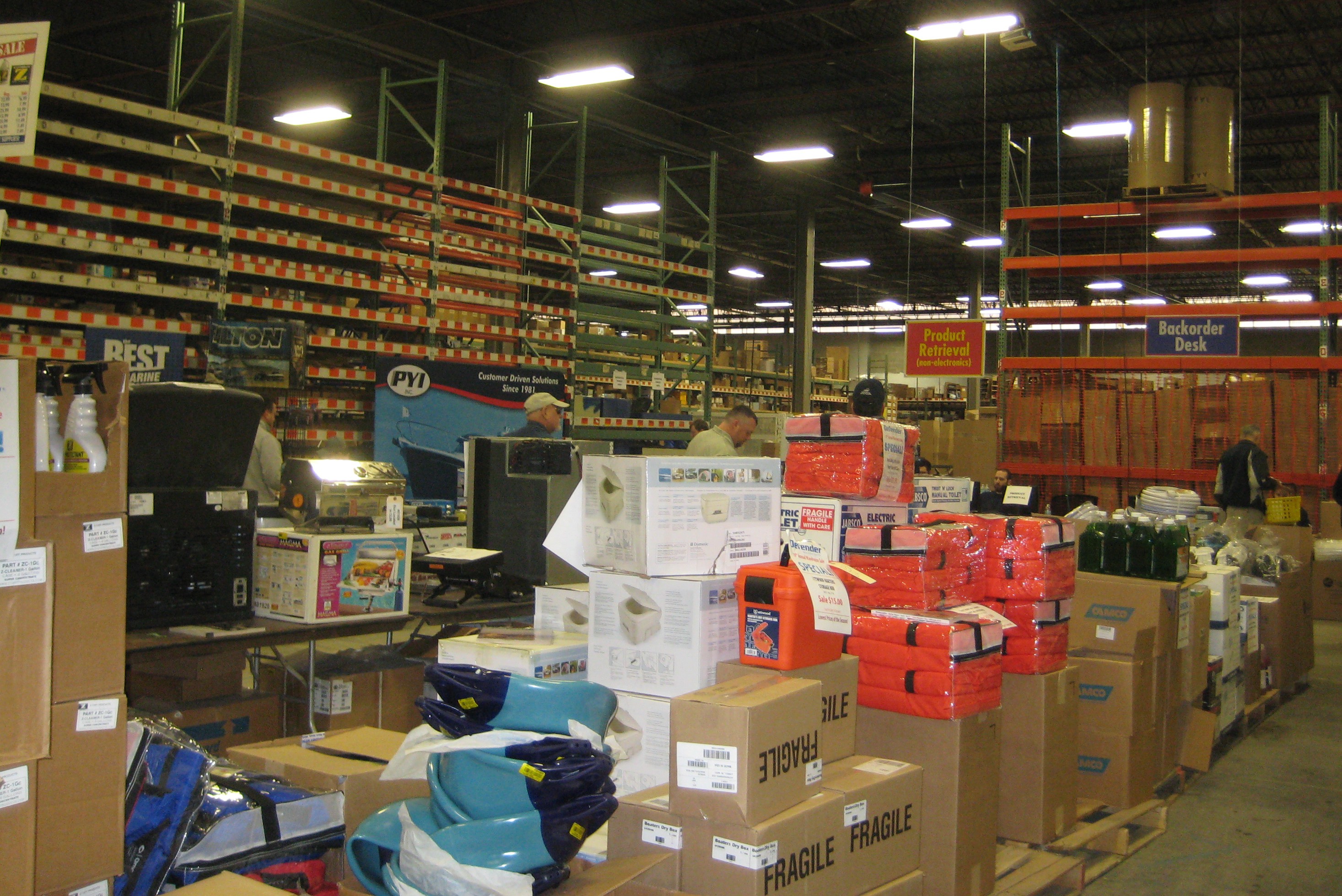
The pickup area is towards the back, along with some of the blow out specials.

And even though the line was VERY long, we were checked out within minutes thanks to all of the registers they set up.  They really do a top-notch job.

There are more registers outside of the camera frame.

As we were driving home later that day with our goodies in the back of the car, we realized that despite our best efforts, we were going to have to go back again the next day.  And my co-worker?  When I saw him today, he said he went back on Sunday too.

And so another season begins.

Hmmm. This doesn’t look like the picture in the book.

There’s still snow on the ground, but we’ve started our weekly trips down to the marina to work on the boat.  At this point we have six weekends left before we are planning to splash Pegu Club for the season (although that may be optimistic if temperatures don’t start getting consistently into the 50’s soon), and we have work to do.

Our first trip of the season was a week and a half ago.  Our plan was to get rid of the snow and ice that had been accumulating in a low spot on the tarp, and wire the fan for the composting toilet (WHOO-HOO!) to the electric panel.  Well, the first goal was accomplished, but by the time Jeff was finished he had no desire to slog back and forth through the snow to bring our tools on board, so we called it an early day and went to the Daniel Packer Inn for a beer and cider.

This is not Jeff's idea of a good time.
This is not Jeff’s idea of a good time.

Last weekend we drove down again hoping for a better outcome.  Temps above freezing all week meant that there wouldn’t be as much snow to hassle with, so we were ready to wire the fan.

We are complete novices when it comes to electrical work, but we had been reading the relevant chapters in our various reference books and felt optimistic.  Pegu Club has a simple 6 circuit panel running off of a 12-volt system.  The fan is currently spliced from one of our LED cabin lights, and the plan was to move the wire to the circuit that currently has the cigarette lighter for charging electronics.

Our first stop was at West Marine to buy some wire.  When the sales clerk asked if we wanted two strand plus ground or simply two strand, we confidently stated two-strand was fine.  I was feeling pretty good, because I actually knew what he was asking!

Down to the marina we went.  We climbed aboard Pegu Club to get to work.  This was going to be easy.  Then we opened up the panel.

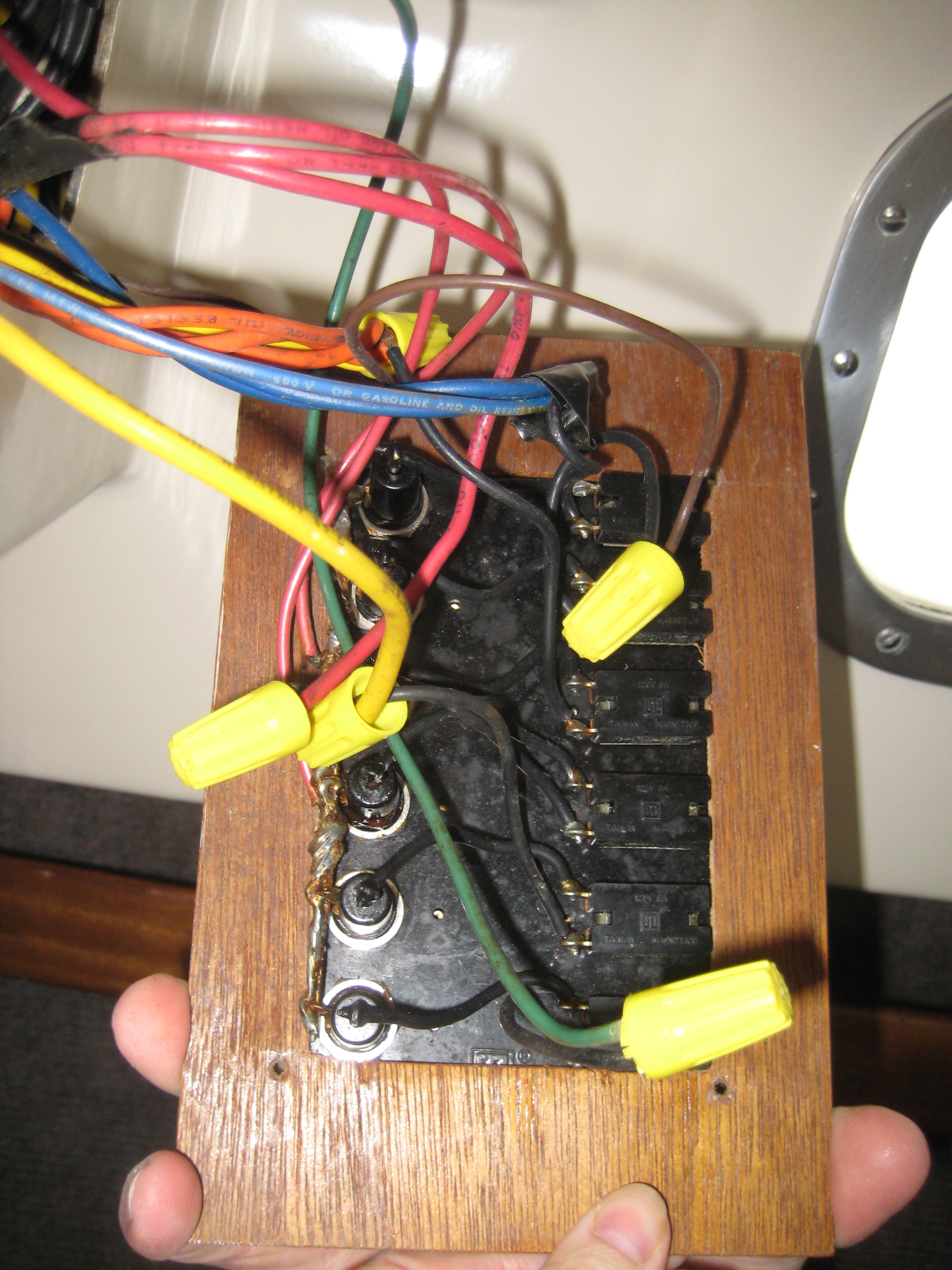
Wait a minute.  Where are the negative and positive wires?
Wait a minute. Where are the negative and positive wires?

Hmmm.  This did not look like any of the pictures in our books.  Where were the negative and positive wires?  What was that wire leading to the switch?  What the…?  This was no longer looking so easy.

I pulled out my phone and hopped on the wifi to try to figure out what we were looking at.  After spinning our wheels for a few minutes we decided that this was not the kind of thing to try to find on a small cell phone screen.  It was going to have to wait for another weekend while we did more research at home.

So the trip wouldn’t be a complete bust, we decided that it was o.k. weather-wise to remove the tarp system we had installed and let Pegu Club see the sunshine once again.  Any snow that falls this time of year will melt quickly, and it will be a lot easier to board her with the ladder.  A few hours later we were finished.

Hello world!
Hello world!

We drove home feeling a bit frustrated that – once again – a simple project was turning out not to be so simple.  However, no one is born knowing about electrics.  We’ll get there.  And one day we’ll be sitting on our big boat, we’ll look back, and we’ll laugh.  In the meantime, we’ll continue to hit the books.  Hopefully this weekend we’ll be able to cross this simple project off of our list.

Spring will be here some day – I think.

Winter started out pretty well.  We had virtually no snow and while it was cold, it wasn’t too extreme.  Then late January came around and it all went to hell.  We’ve had three storms in less than three weeks, and while we’re not as bad off as Boston, it’s bad enough as far as I’m concerned.  Day after day of below-freezing temperatures, and no real end in sight.  March 1st is always spring in my mind, and it can’t come soon enough.  Hopefully we’ll have Pegu Club in the water during the last week of April and this will all be a not-so-distant memory.

In the meantime, we’ve been learning how to use our GoPro and we’re hoping to have some fun videos of our adventures on the Pegu Club this summer.  I decided to experiment with it this morning and make our first video.  There were a few things I would have done differently had I known, but this is a good first try.  Enjoy!

Anchoring – decisions, decisions

Our big goal for this season is to get comfortable with anchoring – including overnight.  Given that we have yet to anchor at all on our boat, perhaps it would be more accurate to say that our goal this season is to anchor!  As future full-time cruisers, anchoring is a skill we’ll definitely need.  There are big savings from not needing to stay on a mooring ball or in a marina every night, so we figured we might as well start working on it now.  Plus, this is an upgrade that we can take with us on the next boat for use as a backup anchor.

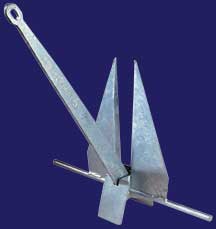
Pegu Club came with a standard Danforth anchor which we aren’t comfortable with using overnight.

Picture from www.danforthanchors.com.
Picture from http://www.danforthanchors.com.

The Danforth is actually not a bad anchor for the generally muddy bottoms that are found in Fishers Island and Long Island Sounds, but they have a reputation for not resetting when the current changes or the wind shifts.  We can get some fairly strong currents (and changeable weather) around here, so we weren’t too keen on testing it out only to find ourselves dragging in the middle of the night.

A new anchor design was introduced several years ago.  Generically referred to as “new generation” anchors, they do an excellent job of holding and resetting when necessary.  From what we’ve read, as long as you anchor properly to begin with, new gen anchors aren’t going anywhere until you’re ready to leave. We had thought about getting one last year but blew the boat budget on other things (Hello, composting toilet!  Whoo-hoo!) so we are very much looking forward to getting a new anchor this year.  As is typical however, given that we’re relative newbies with a 40 year old boat, it isn’t as easy as simply driving down to Defender and buying it.  There are a lot of decisions to be made first:

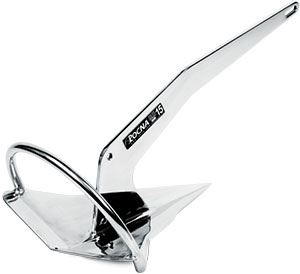
(1) Which new gen anchor to get?  There’s Mantus, Manson, and Rocna – all virtually identical, with near universal acclaim from their owners.  Mantus unbolts for easier storage, but we weren’t crazy about having an anchor that could unbolt, so that was out.  Manson has a dual shank configuration depending on the bottom, but we’ve read mixed reviews as to whether or not that should be relied upon vs. just using a tripline, so that was out.  That left the Rocna.  The people that have it, love it, so that works for us.  Based on the weight and length of our boat, we’ll need one that is 22 pounds.

Picture from www.rocna.com.
Picture from http://www.rocna.com.

(2) How much rode do we need, and of that amount, how much should be chain?  Full-time cruisers typically go with all chain because they’re anchoring in all kinds of wind – from dead calm to tropical storms and stronger.  We’ll be fair-weather anchorers until we’re out full-time, so all chain is overkill for the time being.  Not to mention we don’t have a windlass, which means Jeff will be hauling the anchor up by hand.  I’m calling him the “human windlass.”  Anyway, we’re going with 25′ of chain and 275′ of rope.  This will give us a lot of flexibility for the depths that we can anchor in.

(3) What kind of chain and rope?  For the chain, do we want BBB or high-test?  Rocna recommends high-test, which is stronger, so that one was easy.  For the rope, do we want three-strand or eight-plait?  Eight-plait is a bit more expensive but it doesn’t twist and knot-up, and it doesn’t get as stiff in salt water, so we went with the eight-plait.

(4) Should we connect the anchor to the chain with a shackle or a swivel?  Our research indicated swivels have the potential for more complications.  We like to keep things simple, so we are going with a shackle.

(5) Should we get a snubber?  After more reading, apparently we don’t need one if we aren’t using all chain.  Who knew?

(6) Finally, how are we going to store the anchor on the boat?  We thought about getting a bowroller, but Jeff decided that we didn’t have enough room on the bow for one.  Fortunately, Mantus makes a universal bracket that fits all new-gen anchors and attaches to the bow pulpit.  Of course, it took several more hours of internet research before we were able to figure out whether it would attach to our bow pulpit (since it’s a single rail vs. double), but we finally found the right image the Mantus website which showed us it would work.

I have to say, I was starting to get a bit frustrated with all of the decisions.  It seemed like every time I thought we were all set, we discovered something else that needed an answer (shackle vs. swivel, snubber, etc.).  Then we needed to research the best prices.  I griped to Jeff that just once I would like to be able to decide to get something for the boat, and simply go out and get it.  He pointed out that doesn’t really happen when you have a 40 year old boat.  Given that the next boat won’t be much younger, I guess I’ll just have to get used to it.  At least we have a lot more anchor knowledge so hopefully it will go a bit more quickly with the next boat! But that’s o.k.  It will all be worth it when we’re sipping cocktails on Pegu Club in a cove, all alone, watching the sunset – for free.

Block Island, September 2013

Almost halfway there.

We’re four days away from completing 50% of the offseason.  Pegu Club will be splashed during the week of April 28th, and it can’t come soon enough.

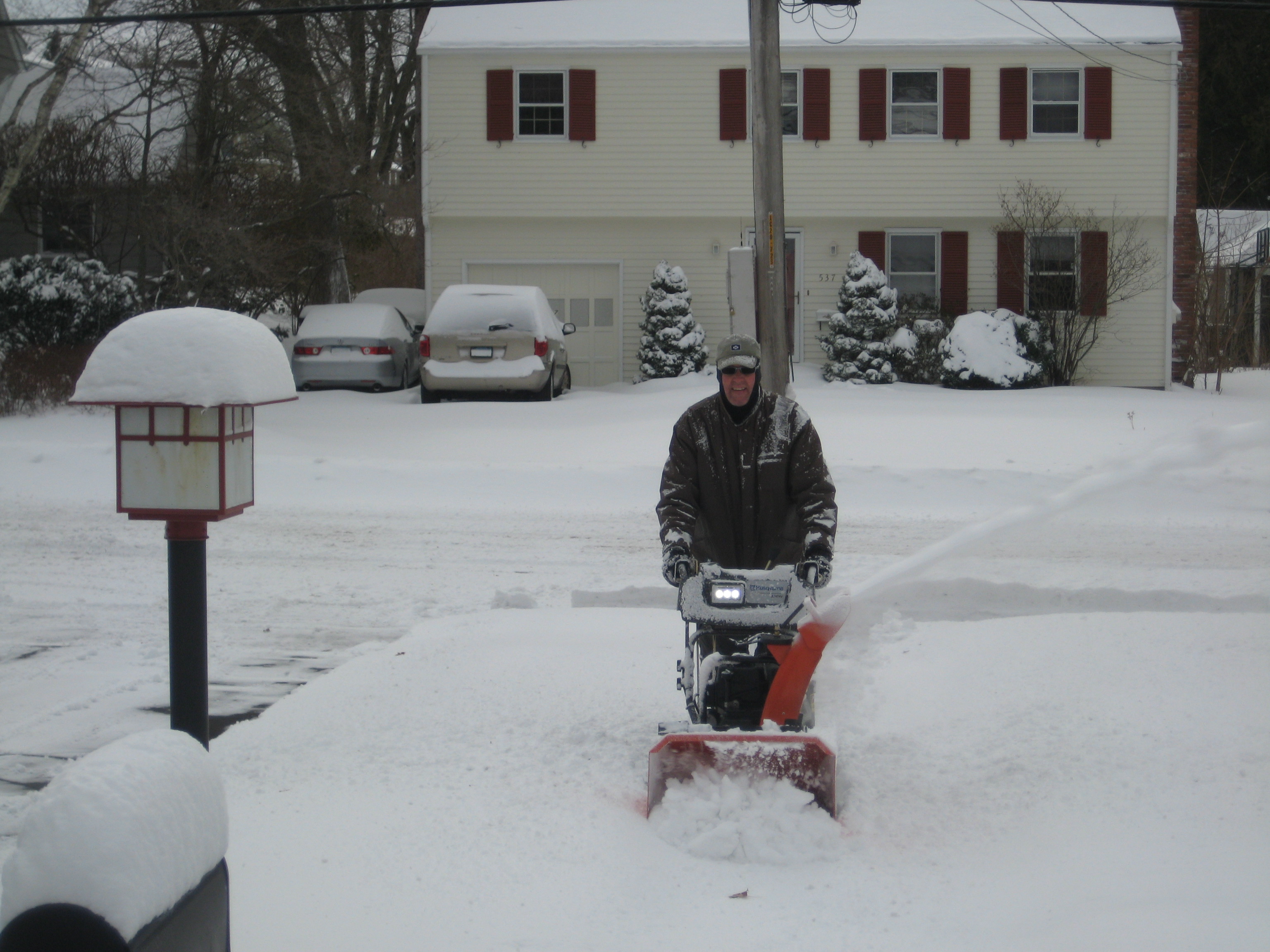
Glad we bought the big snowblower a few years ago!

Since we installed the tarp we’ve been driving down to the marina every two weeks to check on it, but it’s been too cold to do any work on the boat.  Installing the new thru hull and seacock will have to wait until the temperatures warm up enough for the epoxy, and we’ll also have to wait for warmer temperatures before we can take the wood off for sanding and varnishing.  So what have we been doing?

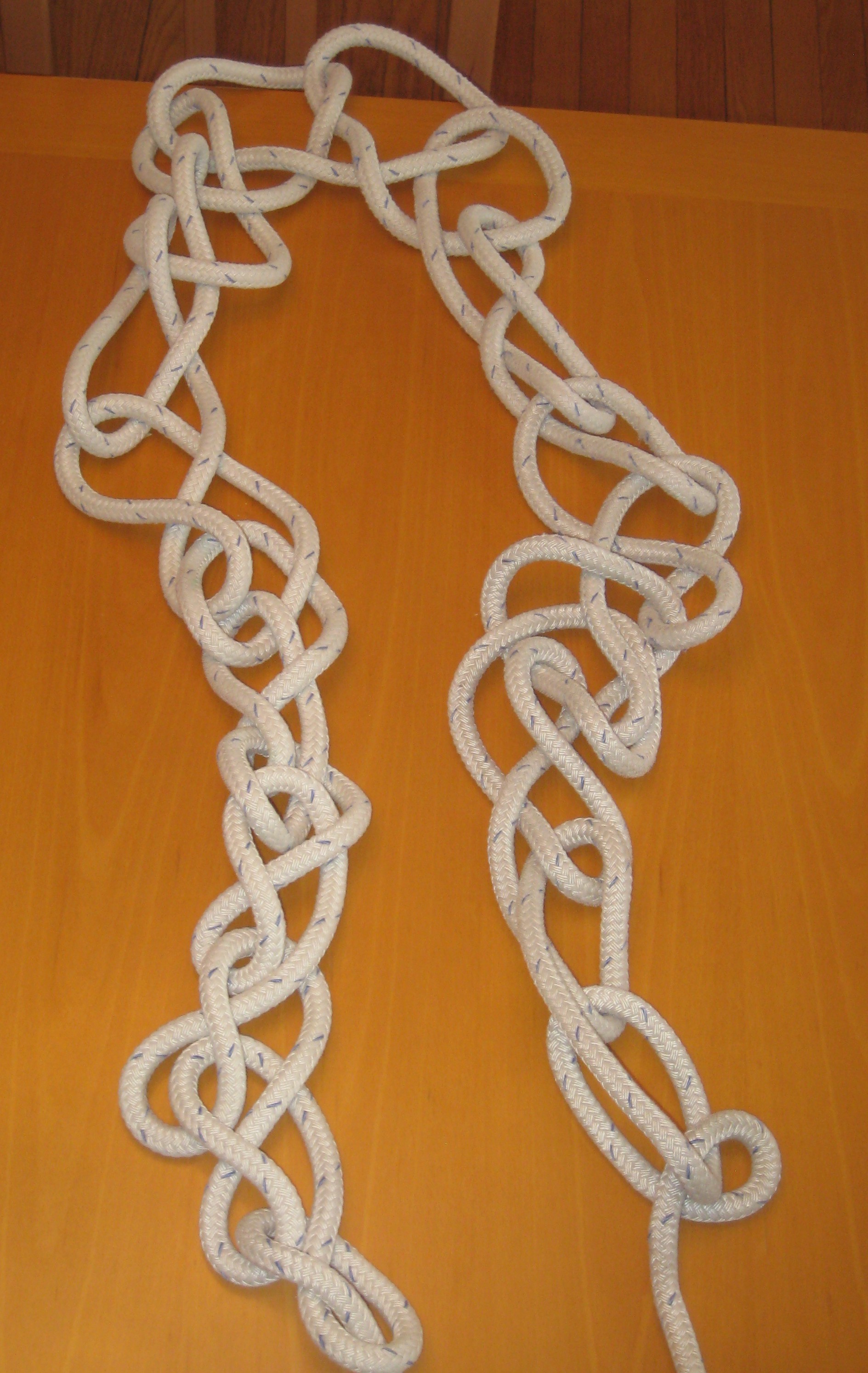
The halyards and sheets need to be cleaned, so I learned how to tie a daisy chain.

IMG_3564

After that they went into a pillowcase (one at a time) to run through the washing machine on gentle and hang dry.

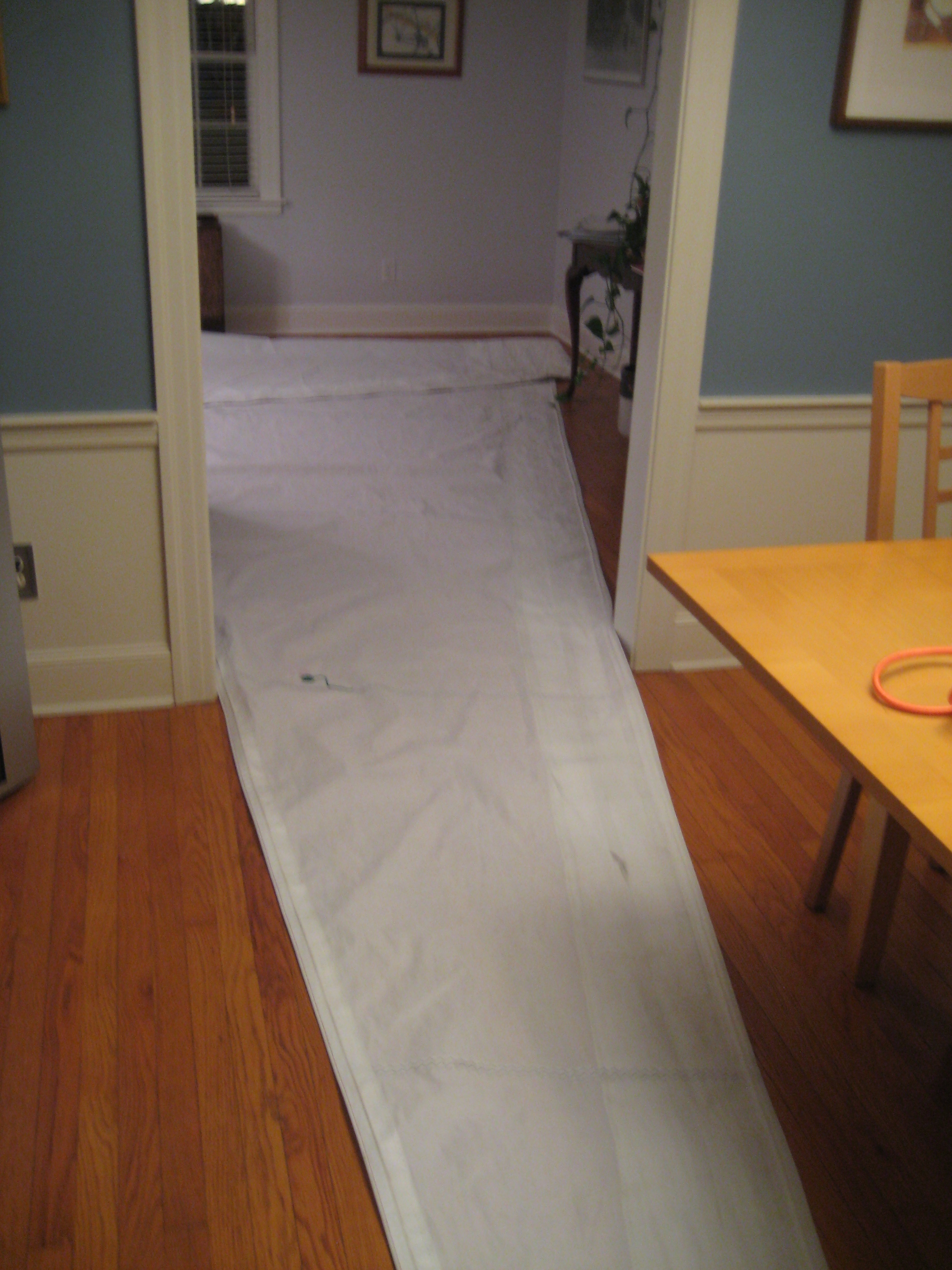
We cleaned the mainsail and jib in the backyard before winter set in.  The clothesline came in handy for the initial drip dry, and then we turned our living room into a sail loft before folding them and storing them in the basement.

The jib fit well, but the mainsail was a bit more challenging.

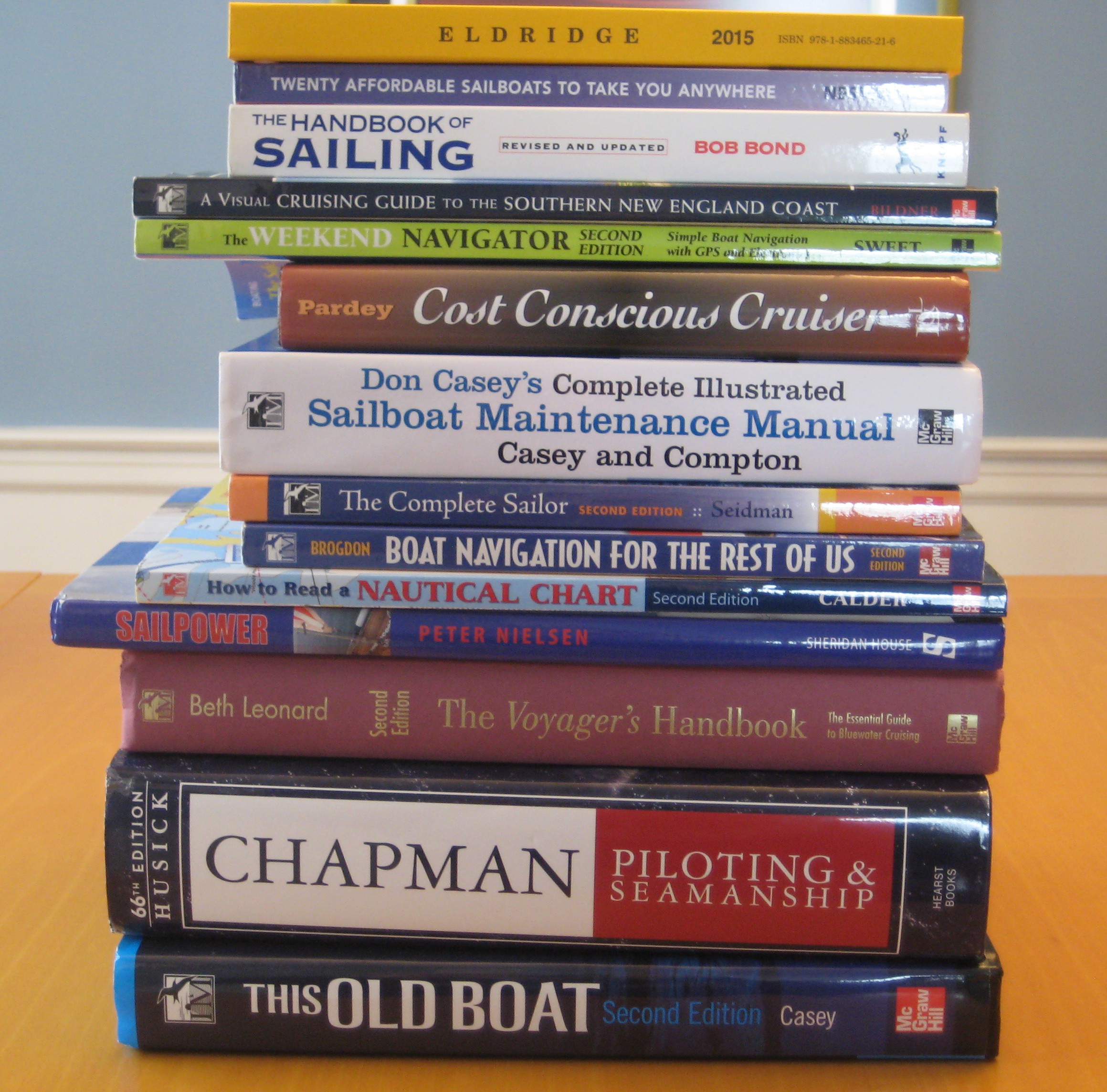
There are always plenty of nautical books to read in the house – everything from navigation to Chapman’s to tips on full-time cruising – and local cruising guides as we think about this year’s vacation.


IMG_3567

We’ve also been spending a lot of time watching YouTube videos of people who are out there cruising full-time, living the dream.  We call it sailing porn.

Finally, we’ve been learning how to use the GoPro that my Uncle Dan sold us – he gave me the special “niece discount” which was very cool of him!  Jeff and I had been talking about how we would like to get one and make some videos to document our adventures, and Dan just so happened to be thinking about selling his, so it worked out great.  Look for some action-packed sailing videos to come this season!

Our DIY boat cover.

When we bought Pegu Club the prior owner said that he didn’t cover her in the winter, so last winter we didn’t cover her either.  However, it quickly became clear that the decision put us squarely in the minority of the other boat owners in our marina.  Typically this wouldn’t really be a big deal, but we had a boatload (ha!) of snow last winter.  We really weren’t crazy about the snow piles that were making themselves at home in the cockpit, so we decided that this winter we would cover her up.

People have a variety of solutions for covering their boats.  Some have custom covers made – $$$.  I may consider making one for her when my sewing skills are sufficiently developed, but for now a custom cover wasn’t an option.  Other people rig up their own system.  I have a co-worker who does this, but he’s an engineer and has a frame that is worthy of his degree.  We knew THAT wasn’t going to happen.  Another option is to have the yard shrink wrap the boat, with an access door if desired.  Initially we chose option three.  But we really weren’t environmentally comfortable with the fact that all of the shrink wrap ends up in a dumpster in the spring, and it was pretty pricy.  Shrink-wrapping our boat with an access door was going to run approximately $475.   Ouch.  So we used our google-fu to find a great description for building a frame (no engineering degree required), we ordered up a 30′ x 40′ tarp on Amazon, and hit Home Depot for the remaining supplies.  That’s how we found ourselves at the marina last weekend constructing our DIY boat cover.

The instructions were pretty simple.  Use PVC pipes to build three arches, another PVC pipe for the spine, some 2 x 4’s to support all of it, a plethora of zip ties and duct tape to hold it all together, and an abundance of rags for every possible chafe point.

IMG_3536
A project that goes more smoothly than expected = a happy Jeff.
The completed frame.

Putting together the frame only took around three hours, and if we hadn’t chosen to sleep in we could have finished that day.  But darkness was falling so we headed home and went back again on Sunday.  Of course first we had to make the obligatory stop at Home Depot for more tarp clips – something I had no idea existed before that weekend.  What an ingenious invention!

Sunday was just as pleasant weather-wise as Saturday had been (bright sunshine and 40 degrees), so after another three hours of wrestling with the tarp and getting it set up just so, we were all set!

Jeff fine-tuning the tarp.
IMG_3541
Pegu Club is snug as a bug in a rug.

Final cost – $200 all in, and we’ll be able to reuse everything.  The tarp will probably only last two or three years, but it was only $90 so it still beats the heck out of $475+ annually for shrink wrap.  Plus, we figured it will take us less time to set up next year now that the wooden braces and the PVC pipes have been cut to size.

We drove down to the marina today to see how it was holding up so far, and all is well.  The weather forecast for Christmas is for heavy rain and winds so that will be a big test, but the boat is fairly protected in its spot.  I also think the 30 tarp clips and the rope tying everything down will help.  Time will tell.

There must have been an almost-blue moon last night.

We’ve discovered over the past two years that boat projects almost always have three characteristics: they take at least twice as long as expected, they cost more than anticipated, and they lead to the realization that another project must be added to the list.  Once in a blue moon, these three things don’t happen.  Well, there must have been an almost-blue moon last night because today we took care of a project that took much less time than we expected, and the cost was under 1/10 of a boat buck (less than ten dollars).  We did end up having to add another project to the list, but two out of three isn’t bad!

During last year’s offseason we replaced the mast light because the original one had lost it’s top before we bought the boat.  Of course a replacement piece wasn’t available, so we needed to buy an entire fixture.  We jury-rigged a fix for the first season but we weren’t comfortable with the possibility of water getting into an electrical item, so we installed a new one.  Being newbies we didn’t test the light before the mast was stepped, and of course once Pegu Club was splashed we realized that the light didn’t work.  It wasn’t a big deal because we weren’t planning on anchoring or sailing overnight last season, so we put it on the list for this winter.

Today saw temperatures in the low 50’s so we decided to take advantage and drove down to the boat to take care of the light.  Our theory was that the ends of the wires were corroded (last season we didn’t know about that possibility), so we brought brought some sandpaper to remove any corrosion.  We also brought electrical wire (yesterday’s trip to Home Depot) and alligator clips (today’s trip to Home Depot) so that we could use the battery from Jeff’s scooter to test our repair (apparently we can learn from our previous mistakes).  The boat battery is sitting in our basement getting a trickle charge, so it made more sense to bring the scooter battery since it’s probably forty pounds lighter.

Jeff got down to work with sanding the wire ends in the light fixture:

IMG_3520


When he went down to the base of the mast to work on the other end of the wires, the problem was immediately apparent:

The top wire is staying together by a single strand.

It appears that when the marina stepped the mast at the beginning of last season, one of the wires ended up getting pinched and almost cut straight through (as seen in the top wire).  Aha!  We’re not sure if it was simply caught underneath and the mast bounced as it was being stepped, or if the mast was actually sitting on the wire.  Either way, that’s why the light didn’t work.  Jeff cleaned the ends, spliced the wires together, and voila:

Let there be light!
Let there be light!

Both lights actually work, by the way.

The cover went back on and in less than 45 minutes after we had started, we were finished.  Amazing.  We high-fived each other, spent the rest of the beautiful afternoon at Mystic Seaport, and finished up with a stop in Stonington to pick up some Bomster scallops for a future Saturday night dinner.  Yum!

One project off of the list.  But what about the new project?  Before we left the house this morning we were researching LED bulbs.  We had intended to swap out the halogen bulb to reduce the electrical draw on this light, because we plan to do some overnight anchoring next season.  It was at that point that the lightbulb went on (ha!) and I realized/remembered that this isn’t an anchor light.  It’s a navigation light.  Anchor lights need to be 360 degrees, and this light obviously is not.  We don’t have an anchor light.  Doh!  So although we have fixed this light, an anchor light has gone onto the list.  Oh well.  Like I said, two out of three isn’t bad.

The offseason work begins.

Just because Pegu Club is out of the water doesn’t mean that we won’t see her again until the spring.  On the contrary – we have plenty of off-season projects planned, and not a lot of time to get cracking until the winter really sets in.

Although the weather has been conspiring against us, we’ve managed to get down to the boat a few times since Pegu Club was hauled out.  The first order of business was to take everything out of the boat so it could be stored in our basement.  And I mean virtually everything: cushions, dishes, pots and pans, lines, sails, winches, the battery, flares, lifejackets, solar panel, etc.  You get the idea.  It did go more quickly this year, however, because we didn’t have to take a bunch of pictures so that we could remember in the spring how everything had been set up.  Not that we won’t still need the pictures.  We’ll just be able to use the old ones again.

Once that was done we gave her a well-deserved bath, scraped the barnacles off of the keel and the propeller, cleaned up the waterline, and polished all of the stainless.  Then it was time to really get started: the first off-season project.

She's no longer a dirty girl.
She’s no longer a dirty girl.

Our first priority is to replace the sink drain seacock.  We discovered at the beginning of our first season that this seacock was weeping.  After some initial hyperventilating, obsessing, and quizzing every boater we knew as to whether we should haul the boat out of the water, we relaxed, closed the seacock, and put a bucket in the sink to do the dishes in.  During the off-season we lapped the seacock, crossed our fingers, and promptly discovered at the beginning of the second season that it was still weeping.  A bit less hyperventilating this time.  The bucket remained in the sink, and replacing the seacock moved to the top of the off-season list.

We did our research, including posting on the Bristol Yahoo group and reading the appropriate section of “This Old Boat” by Don Casey, and went to work.  Jeff did yeoman’s work trying to remove the seacock from the inside, but dynamite wasn’t going to get that thing to budge.  We were going to have to go through the thru hull.  The UPS man delivered a Dremel to the house via Amazon, and we went back the following weekend for a second try.

Jeff busted out the Dremel, took a deep breath, and started cutting.

A man and his Dremel.

It went much more quickly than we anticipated, and before we knew it the thru hull popped out, the seacock was off, and we had a hole in the boat.

IMG_3486
She’s not going anywhere near the water until this hole is filled.

It was a gorgeous day and frankly, if we had known it was going to go that quickly we would have been better prepared to keep working.  Unfortunately, this was all we had planned for the day and it was in the lower 60’s.  We are going to regret this missed opportunity when we’re working outside with temperatures in the 30’s and 40’s.

Back at home, we’ve been researching what seacock we want (Groco), what kind of backing block we want to use (Groco rather than wood), whether to drill the screws through the hull (no), and how to attach the backing plate (still undecided).  We’ve been reminding ourselves that once we’ve finished this, future seacock replacement will go much more quickly!

Sigh. The season comes to an end.

Yesterday was a sad day – the marina e-mailed to tell us that Pegu Club is out of the water for the season.  The only good thing about it is that I don’t have to check the hurricane forecast any more.

The last few weeks of our season was a bit of a disappointment.  After we spent the weekend in Rochester I took Monday off and we headed down to the boat.  The winds were scheduled to be frisky – approximately 15-18 mph – but after all of the windy experience we gained on our vacation we weren’t concerned. It’s funny.  At the beginning of the season 10 mph made us apprehensive.  🙂  There’s no doubt that we’ve gained a lot of confidence during this season.

When we got to the marina Jeff noted that there were an awful lot of whitecaps out on the Sound, but we decided to head out and simply turn around if necessary.  As we were getting ready to cast off the line Tom and Carolyn (from the O’Day that I went on earlier in the summer) arrived at their boat to go for a sail.  We exchanged hellos and started motoring out, waving at Sheldon and Nancy (fellow sailors on a nearby mooring) as we went by.  They were hanging out in their cockpit, relaxing.

As we neared the entrance to the Sound and began leaving the protection of our cove, the waves started picking up.  A lot.  As we kept going it was getting more and more “entertaining.”  They were approximately 2-3 feet, right on the nose, and around 2.5 seconds apart.  It wasn’t the height that was the problem – it was the set.  If they had been 5 or 6 seconds apart it would have been fine.  Instead we started bobbing up and down, the outboard cavitating regularly, and between the cavitation and the wind the boat started getting shoved towards the lee shore (and the rocks).  Jeff and I quickly agreed that it was time to “Run away!” in the words of Monty Python, so I turned the throttle up hard and we were able to turn around and motor back.  We passed Sheldon and Nancy who waved, grinning widely, and motioned for us to come over for drinks once we had the boat squared away.  Tom and Carolyn were still at their mooring when we returned – I think they were waiting to see if we high-tailed it back or not – and we gave them a report.  They wisely decided to stay on the mooring and do boat projects instead.

When we arrived at Sheldon and Nancy’s boat, Sheldon said that the wind had been blowing 20+ all weekend. Ahhh – that explained it.  We’ve discovered that when the conditions are like that for a few days, it takes a day or so for the Sound to settle down.  Sheldon said that as they watched us motor out they looked at each other and said, “They’ll be back.”  Honestly, if we had known that it had been so windy all weekend we likely wouldn’t have bothered going down to the marina on Monday at all, but then we would have missed having a lovely visit hanging out with Sheldon and Nancy and getting better acquainted.  Any time on any boat is a good time, even if we aren’t sailing.

The following weekend Dad and Nikki were in town.  We had all been looking forward to going for a sail together, but Saturday was rainy on the shoreline.  A check of Sunday’s forecast showed that the north wind that had been steadily blowing for a few days was going to clock around, which meant that it was going to die for several hours as is typical.  Unfortunately, it was going to die during the afternoon when it would be “warmer” (mid-50’s).  Morning temperatures were going to be in the low 40’s, and while Dad and Nikki were troupers in being game for temperatures in the 50’s, the 40’s were pushing it.  So no sailing.  The four of us ended up in Boston instead, where we took a Duck tour, so we ended up spending some time on the water after all!

The weekend after Dad and Nikki’s visit was our last chance for a sail.  But once again, mother nature wouldn’t cooperate.  Saturday had wind in the 20’s and Sunday had equally high wind combined with a small craft advisory.  You know what that meant for Monday – whitecaps and 2 second sets for the waves.  So Monday was a no go.  We ended up down at the marina taking down the sails and the boom so the yard guys could haul her, and although we weren’t sailing it was still nice to spend one last day on the water.  We even saw a submarine coming back into New London!  This was our second submarine sighting of the season, and I was just as excited the second time around.

Eventually it was time to say goodbye to Pegu Club as we motored away on the dink, but I told her not to worry – we would see her next weekend on the hard.  As Jeff says, the sailing season has come to an end, but the working on the boat season is just beginning!

Ghosting along on a beautiful day.

Last weekend was a stunner – clear skies, temperatures in the low 80’s – basically mid-August in late September.  So even though the forecast was for very light winds there was no way we were going to pass it up, especially with so few weekends left in the sailing season.

After Jeff got out of work on Saturday we drove down to the boat.  I have to say, after spending two weeks on Pegu Club I was really missing her, so I was very excited.  We settled in, grilled up some burgers, and enjoyed a gorgeous, placid evening.  The wind forecast for Sunday was 5-6 mph, and we were hoping it wouldn’t drop lower because if it did, we weren’t going to be sailing anywhere.

Sunday morning was nice and lazy – and calm.  Flat water, flags hanging straight down.  There was zero wind.  But it was supposed to pick up to that whopping 6 mph in the afternoon, so we held out hope and headed off to Kitchen Little in Mystic for breakfast.  Although I suppose given that we didn’t actually eat until 11:00 a.m., it might be more accurately described as brunch.

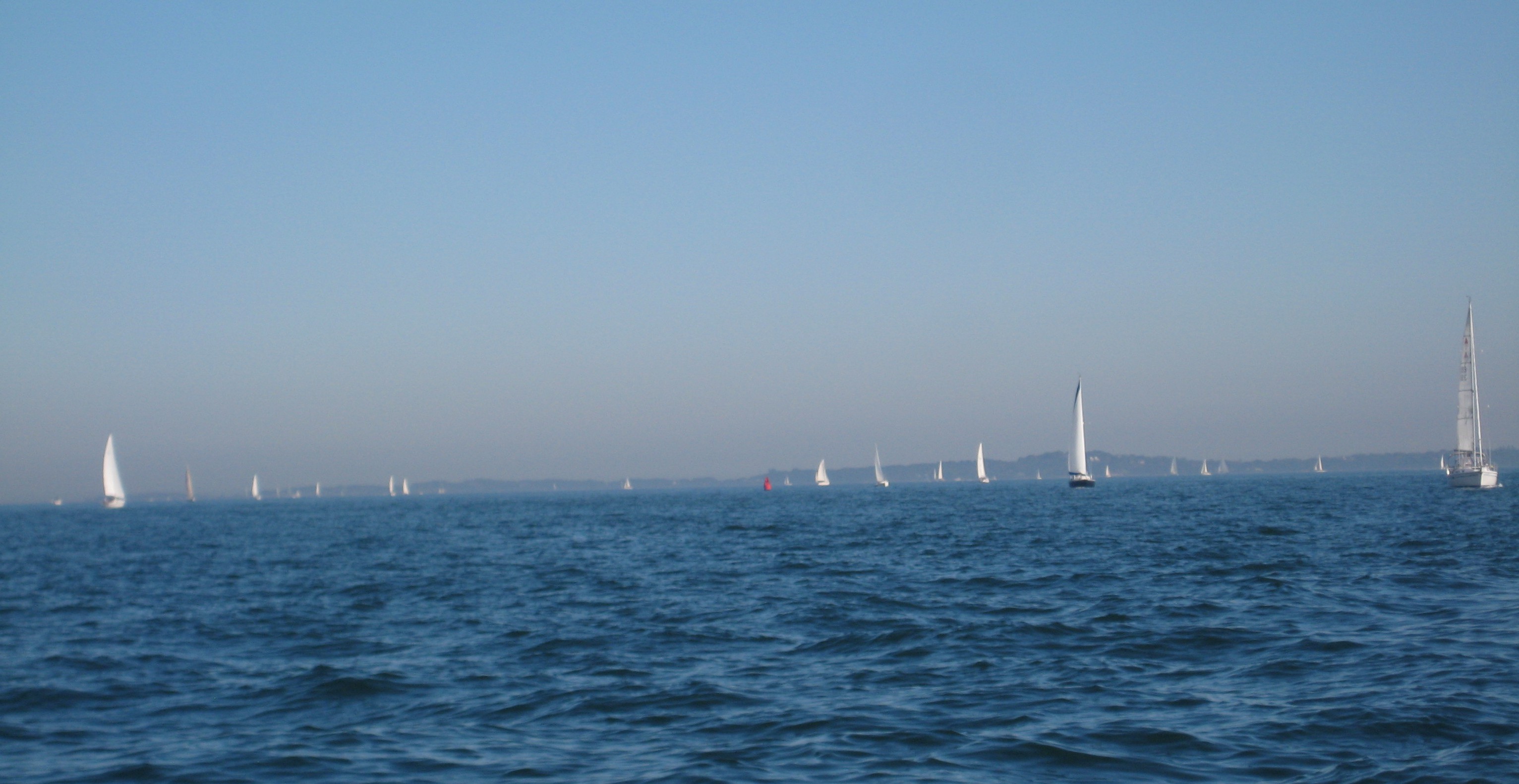
Whispers of wind started stirring around 1:30, so I tore Jeff away from his iPad where he was keeping tabs on the Bills game and we headed out.  Even though there was barely enough wind to sail, there were a TON of boats out enjoying this special treat from mother nature so late in the season.

I don't think I've ever seen so many sailboats out at the same time, except for during a race.
I don’t think I’ve ever seen so many sailboats out at the same time, except for during a race.

The forecast held true and we ended up with around 6-7 mph.  Just enough to peacefully ghost along, making one knot against the current.  We had a major chill going on, and even chatted for a bit with the guy in the sailboat next to us.  Because when you’re both drifting along at one knot, you can do that kind of thing.   It wasn’t frustrating in the slightest – not like when we were on vacation.  After all, we didn’t have anywhere to be and we were sailing in short sleeves in late September.  What was there to be irritated about?

Happy, happy Kimberly at the helm.

For two seasons now, for no particular reason, we’ve headed east when we’ve exited Pine Island.  This time we decided to head west.  It gave us a closer view of New London’s Ledge Light, which we can also see at a distance from our mooring.

Ledge Light.
Ledge Light.

Ledge Light was built in 1909.  According to Lighthousefriends.com, supposedly local residents didn’t want to look at something that was out of place among their large and historic homes.  The result is one of the most striking and unusual-looking lighthouses in the United States.  It’s certainly one of our favorites.

After several hours of chillaxing, we called it a day and reluctantly headed back in.  Though it was far from remarkable as far as the wind was concerned, it was certainly a weekend to savor.

This weekend we’re heading to Rochester for the wedding of Jeff’s nephew, but Monday’s forecast is looking good at the moment, so I may leave work early on Monday so we can go have some more fun on Pegu Club.  She’s scheduled to be hauled out during the week of October 20th so we’d like to take advantage while we can!