Chartplotters, Bits, and Bobs – Defender Warehouse Sale Time!

As the annual Defender Warehouse Sale approached, we casually started making a list.  “You know, we don’t really need much this year” we told each other.  Yet somehow on Sunday the 2nd we found ourselves loading four bags into the car.  What the….

Our sale actually started a week early this year when we picked up a refurbished 7″ B&G Zeus2 chartplotter for $500.  We’ve been using iNavX as a chartplotter on our iPad ever since we bought little Bristol, and although it was o.k. we always knew we would eventually buy a real chartplotter.  We can’t see the iPad screen in the sunlight, it’s not waterproof, it needs to stay out of the sun so it won’t overheat, and we have to keep an eye on the battery.  While it works for some people, it really wasn’t what we wanted to use when we head out full time.  We wanted something waterproof that we could hard wire and see in bright sunlight.

Continue reading “Chartplotters, Bits, and Bobs – Defender Warehouse Sale Time!”

That sucker is stuck.

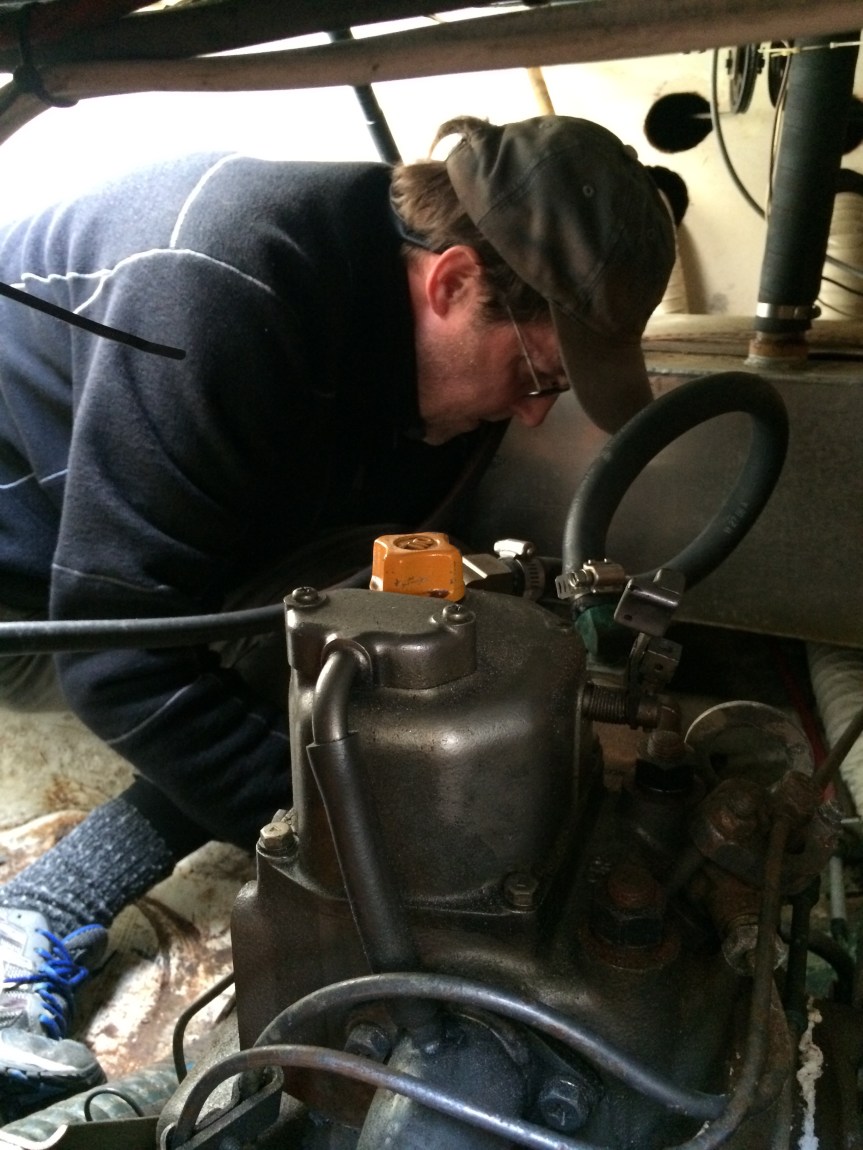
After taking care of our propeller shaft stuffing box last fall, it was time to turn our attention to the rudder shaft stuffing box.  Jeff had noticed during last season that the hose surrounding the stuffing box was very old with many signs of serious cracks.  Given that a rupture of the hose would result in a significant amount of ocean water coming into the boat, we knew we needed to take care of it this offseason.

Unable to find anything online about servicing the rudder shaft stuffing box, we were essentially going to have to go in blind for this project.  Not surprisingly with a 40 year old boat, its been a challenge, and unfortunately we’re not finished yet.

Continue reading “That sucker is stuck.”

Sold!

images

Well that didn’t take long.  After one day on the market the house was sold to the second person that saw it.  One week later we started looking for apartments.

Our luck continued with the first apartment we saw being almost perfect, so after looking at a few others we called the landlord and took it.  At two bedrooms and 1200 square feet, it’s only slightly smaller than our house and aesthetically fits our style to a T.  There is a washer and dryer in the basement, it has gas heat (and a gas stove), more storage than we need, and it’s in the neighborhood we want.  The only drawback is it’s a slightly longer walk to work than I preferred, but I could certainly use the exercise.  Jeff’s work is actually closer now so I teased him that I should just take the car, but honestly I really do enjoy walking to work and wouldn’t want to give it up.

The closing was yesterday.  I thought that I would be sad to be leaving the house, but surprisingly I really wasn’t.  Sure, there were a few tears as I vacuumed over the weekend while we worked to make it broom clean.  After all, at just short of eleven years this is the longest I’ve ever lived in one place in my entire life.  Different memories came to mind as I moved through each room.  But I also saw things that needed to be done (“The floors really need to be refinished.”  The trim in the bedroom has to be repainted”), and I was so thankful that we don’t have to be the ones to do them. Continue reading “Sold!”

Back at it!

Now that we don’t have to focus on getting the house ready to sell, we can turn our attention back to Pegu Club.  With splash planned for the end of next month, it’s not a moment too soon!

This past weekend was bitterly cold with highs in the 20’s and low 30’s – not good boat work weather.  However, we did want to check on Pegu Club and take stock of what we need to do over the next six weeks, so we bundled up and drove down to Shenny.

All looked well with Pegu Club.  A Softsoap container in the head had cracked from the below-freezing temperatures over the winter (that’s going to be one clean countertop), and we saw that we had narrowly avoided a minor flood from a 2 gallon jug of water.  It had frozen solid, and with no real room to expand the side was bulging and cracked.  Jeff said it’s a good thing it hadn’t thawed, because 2 gallons of water would have poured all over the floor.  Lesson learned.

Continue reading “Back at it!”

Visiting our standing rigging.

The house goes on the market one week from today (hooray!) and then we can turn our full attention back to the boat.  In the meantime, last Saturday we did get the chance to have some fun when we drove down to Sound Rigging Services (SRS) in Essex to check out the mast repair and our new standing rigging.

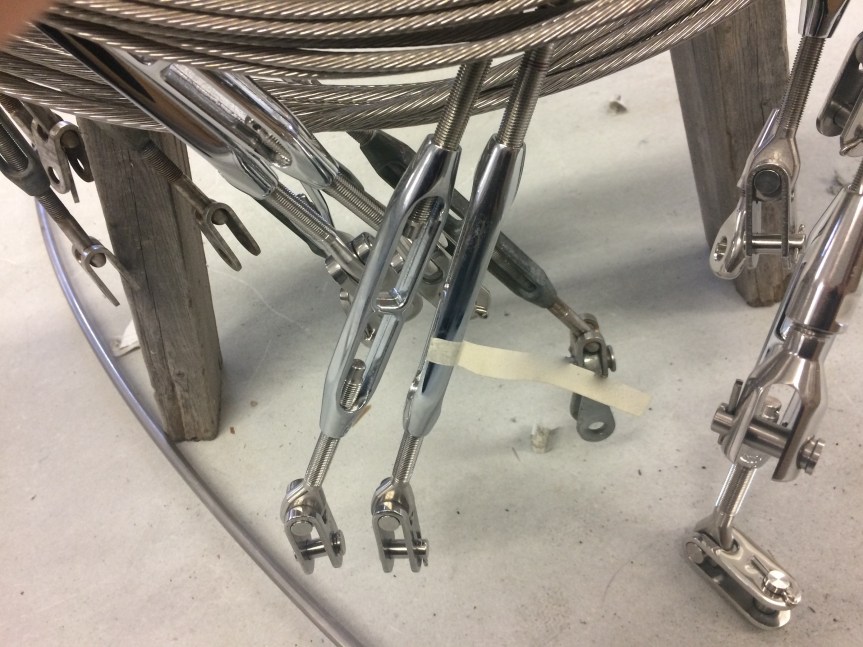
You may recall from the previous post on our dented mast that Chuck Poindexter from SRS had also found a crack in our existing standing rigging, so fixing the mast and getting new standing rigging became priority number one for this off-season.  We had decided to go with Hi-Mod swageless terminals so that we could easily replace it ourselves in the future, and Chuck had offered to have us down to his shop so we could practice assembling a Hi-Mod terminal.

Continue reading “Visiting our standing rigging.”

Our book of dreams.

unknown

Jimmy Cornell’s World Cruising Routes.  I hadn’t heard of this book when I first saw it at Defender, but flipping through its pages I knew I wanted it.  It has nearly 1,000 sailing routes all around the world – information on winds, currents, tropical storm season, best time to go, etc.  With a price tag of $55.99 and several years to go before we leave, however, I decided to resist.  Researching the book a bit later, I discovered that this book is one of THE books that most cruisers have on their boats. The information in it is indispensable, and we were definitely going to buy it at the beginning of our final winter before cutting the lines.

Flash forward a few months later, and a co-worker was asking me what would be our first foreign country in Pegu Club.  It’s something Jeff and I enjoy batting around, so I told him right now we were thinking maybe Maine for the summer, then down the ICW to the Bahamas and into the Windwards via Bruce Van Sant’s “Thornless Path.”  It’s a common route for snowbirds.  “Really?  You wouldn’t want to go someplace else?”  It lit a spark.  I started thinking.  It reminded me that we don’t have to do the “standard” route.  In fact, that’s not really our style.  Where else would we want to go?  And that made me think of the Cornell book again.

Continue reading “Our book of dreams.”

Another step towards cutting the dock lines – we’re selling the house.

unknown

Ever since deciding that we want to cruise full-time we’ve been in major savings mode.  Sometimes we ruefully say that if we had been this serious years ago we’d already be out there, but there’s no sense in looking back with regrets.  Instead, we are thankful that we smartened up when we did, and we keep pushing forward.

Readers may notice that we have not been working on boat projects every weekend during this offseason.  That’s because our focus has been on the house so we can put it on the market in February.  Yep, we’re selling the house.

Ever since making this decision, it’s been easy to tell who didn’t really believe that we plan to sell everything and sail away.  It’s the people who look shocked when we mention we’re selling the house in the spring and moving into an apartment for three years.  Invariably, their response is “Wow, you’re really going to do this?!”  Yes, we are.

After crunching some numbers it became crystal clear that living in our house vs. renting an apartment is costing us a fortune in potential savings.  Connecticut has very high property taxes and we live in a town that is among the highest in the state: we paid $7,300 in property taxes this year for our 2 bedroom, 1.5 bath cape cod-style house.  Between taxes, the mortgage itself, and property insurance, it adds up big-time.

Continue reading “Another step towards cutting the dock lines – we’re selling the house.”

“You’re doing what??” Yes, we’re switching to hank-ons.

Installing new rigging meant that it was finally time to pull the trigger on something we had been thinking about for a while – removing the furler and switching to a hank-on jib.

Currently our headsail is on a furler which is what you see on the vast majority of sailboats nowadays. A furler allows you to simply pull on a line when you’re finished using the jib, rolling it around a foil. Basically the jib is always hoisted, but it rolls up when you’re not using it. When you need to reduce the sail because of high winds, you roll it up part way which reduces the sail but also reduces how closely you can point into the wind.  Since we have a sloop (which means there is only one headstay), having a furler meant that to change to a different headsail (a storm sail for example) would involve unfurling the sail entirely (while it flogs in the wind), dropping the sail, putting the new one on by inserting it into the slot (which means raising it higher as you go, while it’s unfurled and flogging in the wind), then furling it after it’s fully raised.  We had changed our headsail once when we had Little Bristol, and we had also installed and removed the sails each year at the beginning and end of each season (and once last season in anticipation of the hurricane that didn’t arrive).  It’s a royal pain.

Before furlers were invented, headsails were hanked on. Hanked on jibs have small pistons along the luff of the sail which are clipped around the forestay before raising the sail.  The sail can stay on the deck while it’s hanked on, so it’s not flogging like a furling sail.  Hanked on jibs can have a reef point put in so that you can roll up the bottom of the sail to a certain point rather than changing to a smaller sail. This doesn’t impact your pointing ability. Changing the sail involves dropping it, unhanking it and removing the jib sheets, hanking on a new one and installing the jib sheets, and raising the new sail.

We decided awhile ago that when we replaced the standing rigging we’d also remove the furler and switch to hank on headsails. This definitely goes against popular convention, but we have several reasons for doing this: we don’t like how poorly the boat points when the jib is partially furled; we don’t want to spend the money on adding a solent stay, so if we kept the furler but needed to switch to a storm jib, we’d have to completely unfurl the sail before dropping it – a task that’s not appealing in high winds; and we like how hank on jibs are bullet proof – no furler to break down or maintain. So, consistent with our desire to keep things simple, we’re going hank on.

Continue reading ““You’re doing what??” Yes, we’re switching to hank-ons.”

Well look at that. There’s a dent in our mast.

Last spring we were working on the mast when we noticed there was a dent in it.  It was clear that something compressed the upper tang, causing a dent.  The upper tang looked normal, so it must have been pulled out again.  We hadn’t noticed it when the mast was previously unstepped, but maybe we simply didn’t see it.  Regardless, it doesn’t matter when or how, it was there.

img_0433
That’s a bummer.

We decided to ignore it for the season and deal with it later.  We weren’t planning on intentionally sailing in rough conditions nor out on the high seas, so we figured we’d take our chances.  But when we unstepped the mast last month, we knew it was time to address the situation.

Continue reading “Well look at that. There’s a dent in our mast.”

Now we know why it’s called a stuffing box.

Since buying Little Bristol four years ago, we’ve heard boaters refer to a mysterious “stuffing box.”  Tom, who we bought Little Bristol from, told us when we were first looking at her that he had recently done the stuffing box, making a face that indicated it was a real pain so we should be glad that he had taken care of it.  We nodded sympathetically like we knew what he was talking about, all the while thinking “Stuffing box??” to ourselves.

When we bought Pegu Club we didn’t know when the stuffing box had last been taken care of, and frankly, we still didn’t know what it was.  We just knew that water dripped from it when the propeller shaft turned.  Apparently you want it to drip, but not too much.  This season there was plenty of evidence that it was dripping, so we tucked it away in the back of our minds as a possible off-season project.  Then Jeff noticed that the hose that clamps around the stern tube and keeps the ocean out of our boat had definitely seen better days, judging by the number of cracks in it.  Now replacing the hose was definitely on the to-do list for this off-season.  Since we needed to remove the stuffing box in order to access the hose, we figured we might as well take care of both of the stuffing boxes while we were at it.

Our various books told us that there is a stuffing box for the propeller shaft and another one for the rudder stock.  The stuffing box is a threaded sleeve and a hollow nut through which the propeller shaft (and rudder stock) passes through.  The sleeve (or sometimes the nut) is filled with a material that forms a watertight seal but still allows the propeller shaft to turn.  Water is required to lubricate the material, so the stuffing box needs to drip when the shaft it turning (unless you have a dripless system).  Great.  Now that we knew what it was (and what it looked like), it was time to have at it.

Continue reading “Now we know why it’s called a stuffing box.”